
If you spend any amount of time around cider people, sooner or later you’re bound to hear the term “Full Juice” But what do we mean by it, and why do some people seem to think it’s the be all and end all of cider making?
To understand that, we have to look at what cider actually is—and, perhaps more importantly, what the law says it can be.
Not all that glitters…
Let’s start with a basic truth about value.
If you buy a 24-carat gold ring, you are buying 100% pure gold. If you buy a 9-carat gold ring, you are buying 37.5% gold mixed with other, cheaper metals.
Both are sold as “gold rings,” but one contains significantly less actual gold than the other. You wouldn’t expect them to be the same price.
Now, let’s look at cider.
Cider is fermented apple juice. (Not “made with” juice, not “flavoured with” juice… it IS the juice, transformed). Therefore, logically: Real Cider = 100% Fermented Apple Juice. Going back to the above analogy, juice content = gold content.
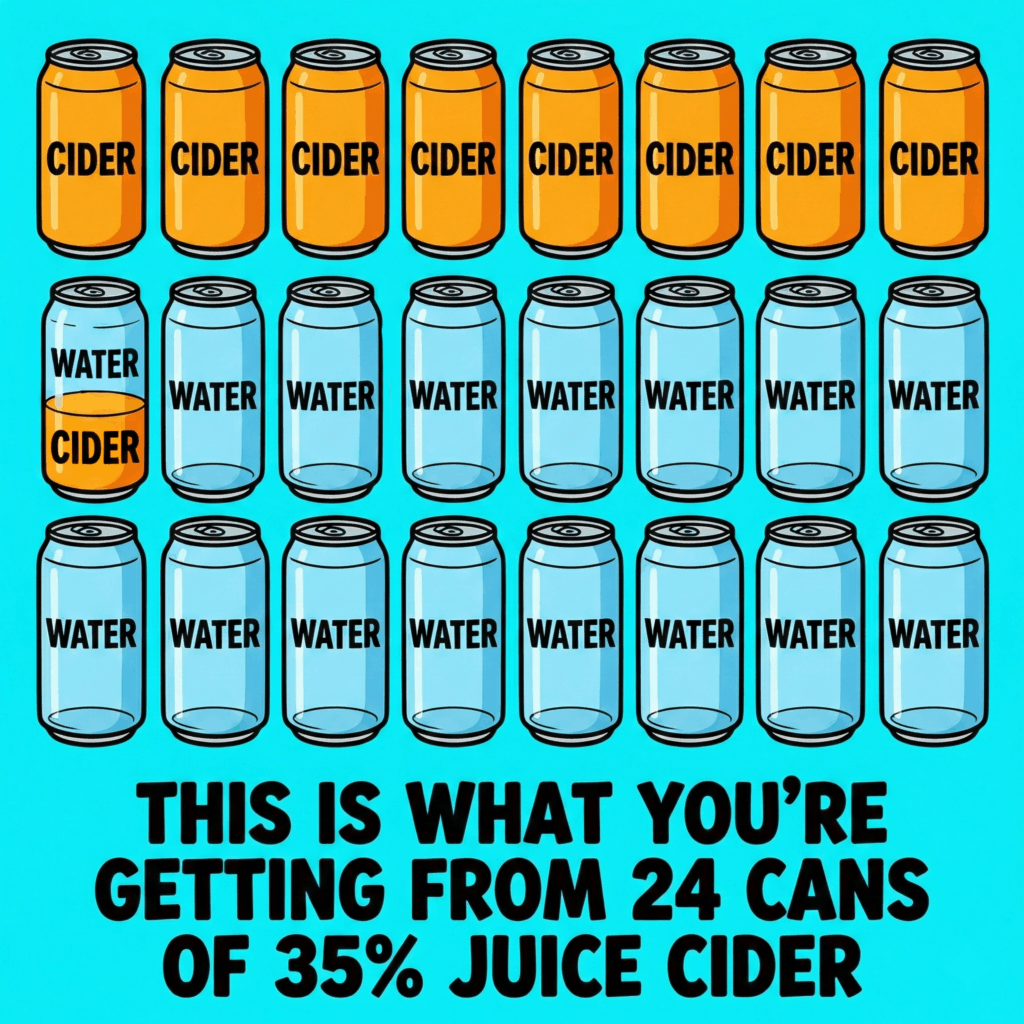
However, UK law allows a drink to be sold as “Cider” even if it only contains 35% fermented juice. The rest is mostly water, sugar and preservatives.
So, if you buy a standard mass-market cider, you are essentially buying the “9-carat” version. The drink in your glass is 35% cider and 65% water. This distinction is critical because it completely changes the maths on whether that “cheap” bottle is actually good value.
The Value for Money Myth
Cider drinkers talk about juice content because they care about quality and provenance. But perhaps the most compelling argument for Full Juice is actually value for money.
At first glance, mass-market cider seems cheaper. Let’s look at the maths:
- National Brand: £2.65 per 500ml bottle.
- Full Juice Cider: £3.50 per 500ml bottle.
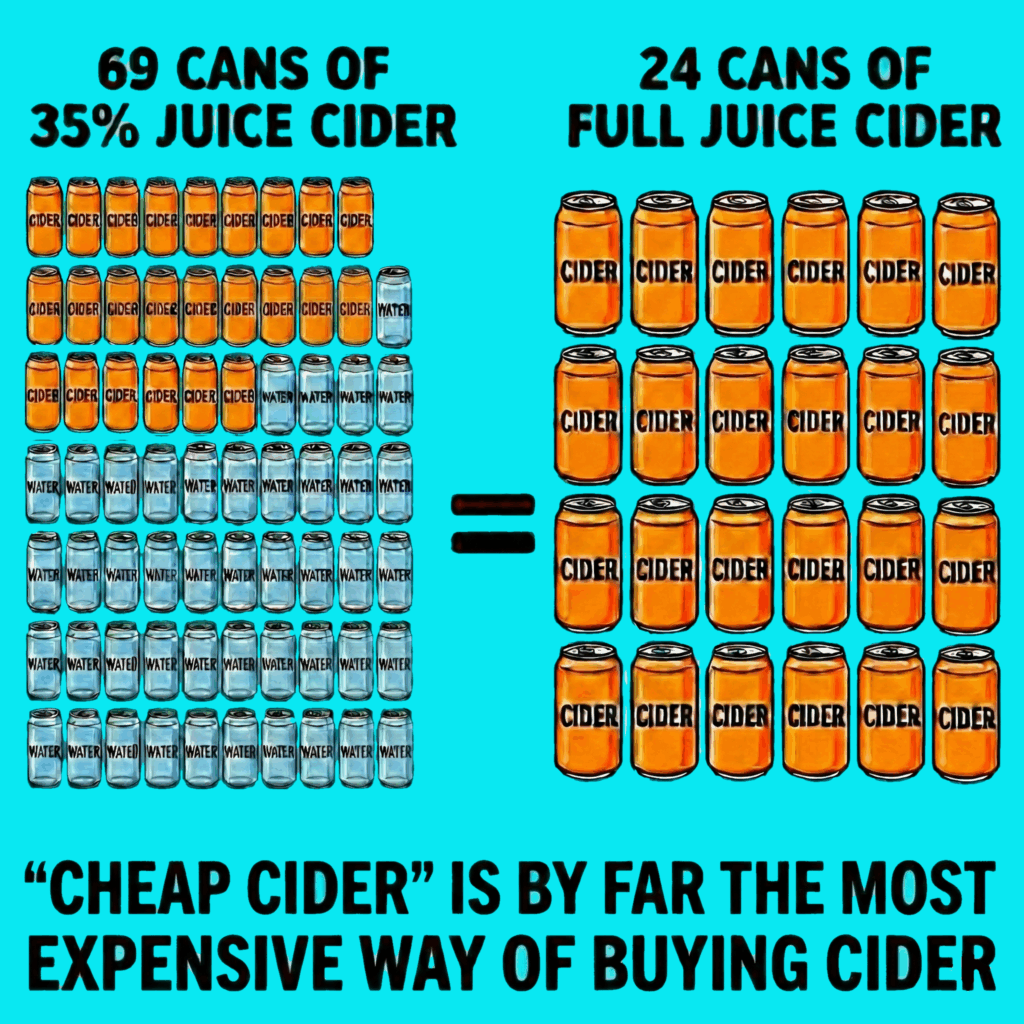
On the face of it, the National Brand is a bargain. But remember: 65% of that bottle is water. And who wants to pay premium prices for water?
If we adjust the price to only pay for the actual cider content:
- National Brand: Costs roughly £7.57 per 500ml of actual cider.
- Full Juice Cider: Costs £3.50 per 500ml of actual cider.
The verdict: Cheap ciders only appear to be cheap because they are watered down. If you buy 24 cans of “bargain” cider, the equivalent of 15.6 of them are just very, very expensive water.
The Taste Test
How can you tell the difference between 65% water “cider” and real cider? The easiest way is to trust your palate. Try this experiment at home:
- Fill one glass with apple juice.
- Fill a second glass 1/3 full with juice, then top it up with water.
- Taste them.
You’ll notice the second glass is paler, less sweet, and feels “thin.” Even if you add sugar to the watered-down glass to match the sweetness, it will still lack body and flavour.
Imagine if this dilution happened right in front of you at the pub:
Customer: “How much for a pint of cider?”
Landlord: “That’ll be £6.”
Customer: “Bit steep!”
Landlord: “OK, I can give you a third of a pint for £3 and top it up with tap water?”
Customer: “Bargain!”
Said no one, ever.
Top Shelf Cider
When I think of food quality, I often think of the humble sausage, mainly because they have such a large range in terms of quality and price but regardless of these differences they are all just called sausages. We all know cheap sausages have less meat. It’s easy to spot because the ingredients are printed on the pack, and the price usually reflects this quality.
One of the unique things about cider in the supermarket is that it doesn’t have a “middle shelf.” When I looked at Tesco cider prices last year, I found them to be bizarrely uniform:
- The “Premium” Shelf: Thatchers, Kopparberg, Westons, Rekorderlig, Magners, Bulmers… almost all sat between £2.50 and £2.65
- The Bottom Shelf: Just consisted of Crumpton Oaks at £1.00 or larger format versions of the premium shelf above (i.e. 2 liters of Westons Vintage rather than a 500ml glass bottle of Westons Vintage)
In the beer aisle, you have a clear progression from cheap lager (£2/ltr) to craft beers (£4.55/ltr) with regional ales occupying the middle ground. The wine aisle is much the same, cheap national wine moving through mid level new world wines up to the premium wines from the established regions.
In cider, there is no middle ground. Either the supermarket only deals in genuinely premium cider (unlikely), or some of these brands are telling fibs about their actual value / quality.
How to Spot the Good Stuff
Since mass-market brands rarely advertise that they are only 35% juice, it’s hard to tell what you’re buying. However, here are a couple of tips:
- Look for “Full Juice” or “100% Juice”: If a label claims it, it’s usually true (thanks to Trading Standards).
- Check the Ingredients (If you can find them): Most ciders don’t list ingredients. Of the list of mainstream producers mentioned earlier, only Bulmers did. Their list? Apple juice from concentrate (66%), water, glucose syrup, preservatives.
Note on Concentrate: “Apple juice from concentrate” is itself mostly water. By listing it first, they avoid putting “Water” at the top of the list. We can all guess where that sits on the quality / value scale.
You’re unlikely to find the real stuff in the supermarket just yet but keep an eye out at local farm shops, independent off-licences, or specialist online retailers.
Happy cider hunting!
Ryan
A Note on the “Cheapest” Option As an aside, the cheapest cider on the list, Crumpton Oaks (85p), won a silver medal at the World Cider Awards 2019. It describes itself as “expertly blended.” Why not buy a bottle for less than a quid and see if you agree with the judges? I’m sure they’d love to hear your thoughts.
Comments are closed