
I am firmly in the ever-increasing camp of cider makers who believe we must revisit the UK’s legal definition of cider. If we don’t, the industry risks sliding back to where it was 20 years ago—creating products that appeal predominantly to underage drinkers and those dependent on cheap alcohol.
The problem lies in a government document known as HMRC Notice 162.
This document defines what is and isn’t “cider” for tax purposes in this country. As it stands, this definition allows a product made from just 35% reconstituted apple juice concentrate (essentially water and syrup) to sit comfortably on a shelf beside a cider made from 100% fresh pressed apple juice.
Both are sold under the generic term “cider.”
A Tale of Two Ciders
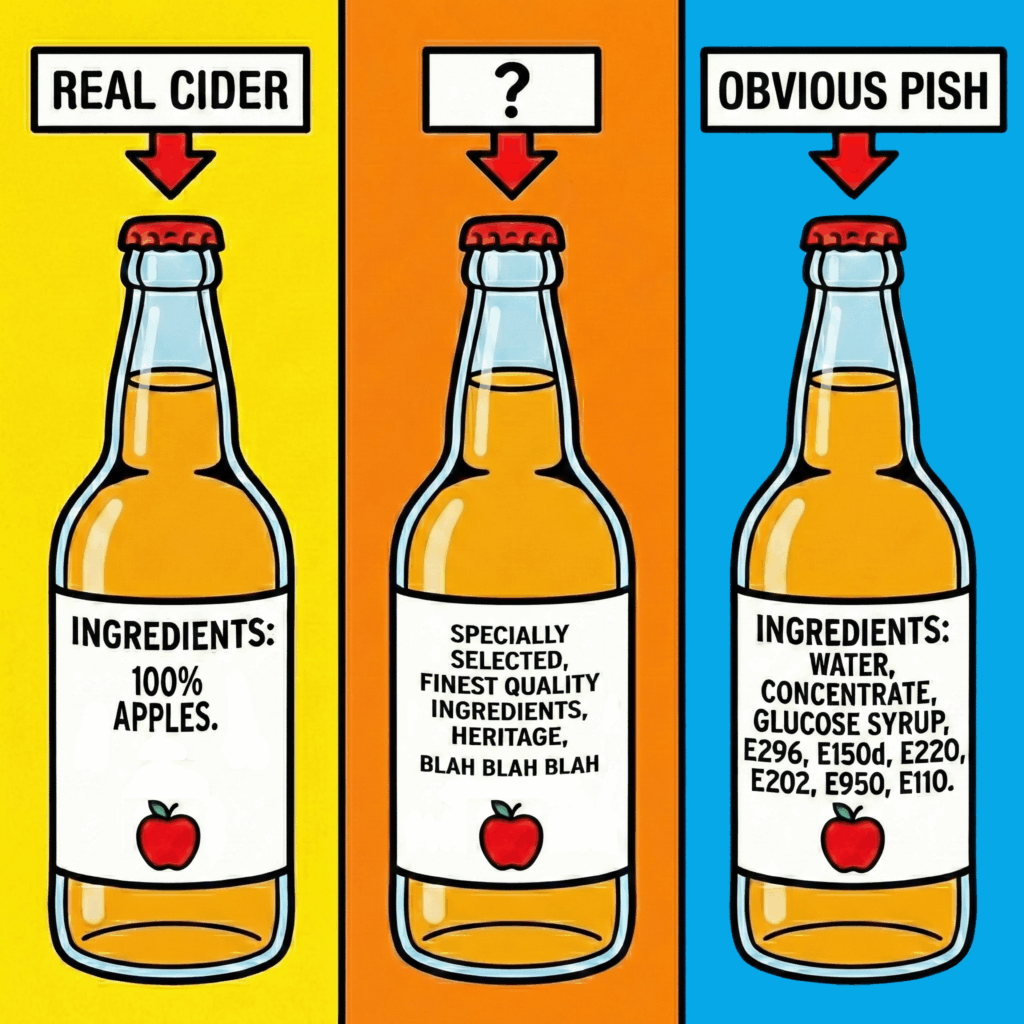
All ciders are not made equal. Yet, if two hypothetical bottles sat side-by-side on a supermarket shelf, how would a drinker tell the difference?
They might have similar packaging. Both might be described as “Craft” or “Premium.” Both might make vague claims about authenticity and tradition. Without compulsory labelling, telling them apart is nearly impossible.
If the law required ingredient lists, the difference would be stark:
- Cider A (The Real Deal): Apple Juice (not from concentrate).
- Cider B (The Minimum Standard): Water, Apple Juice (from concentrate), Glucose, Malic Acid (E296), Caramel (E150d), Carbon Dioxide, Sodium Metabisulphite (E220), Potassium Sorbate (E202).
The “41 Ingredients” Problem
Most people have a genuine and legitimate belief that cider is made from apples. They would almost certainly be shocked to learn that cider—as defined by Notice 162—can contain anything up to 41 permitted ingredients.
This list begins with the scientifically named Acesulfame K and runs all the way through to the equally artificial, albeit poetically named, Sunset Yellow.
Currently, producers are only legally required to display Sulphites (as an allergen) or note if artificial sweeteners are present. Everything else can remain hidden.
Below is the full breakdown of what Notice 162 permits in your pint, categorised by function:
| Category | Permitted Ingredients |
| The Base | Apple juice (fresh or concentrate), Water, Apple wine, Pear juice/wine (for Perry). |
| Sweeteners | Acesulfame-K (E950), Aspartame (E951), Neo-hesperidine, Saccharin (E954), Sucralose (E955), Sugars (High fructose corn syrup, Glucose, Sucrose, etc.) |
| Acids & Salts | Acetic acid, Ascorbic acid (E300–E302), Citric acid (E330–E333), Lactic acid (E270), Malic acid (E296), Tartaric acid (E334–E336), Salt (Sodium chloride). |
| Preservatives | Dimethyl dicarbonate (Velcorin/E242), Sorbic acid (E200-E203), Sulphur dioxide (E220–E228). |
| Colourings | Acid brilliant green (E142), Anthocyanin (Red/Purple E163), Caramel (Brown E150), Carmoisine (Red E122), Cochineal (Red E120), Indigotine (Purple E132), Mixed Carotenes (Orange E160), Ponceau 4R (Red E124), Quinoline yellow (E104), Sunset yellow (E110), Tartrazine (Yellow E102). |
| Other | Apple/Pear aromas (natural only), Carbon dioxide, Nitrogen, De-alcoholised concentrated cider, Cider vinegar. |
A Fair Pint
Selling a product made from a cocktail of industrial ingredients without informing the consumer is, quite simply, unfair.
Consider the wine industry. In EU and UK legislation, wine is strictly defined as a “product obtained exclusively from the total or partial alcoholic fermentation of fresh grapes, whether or not crushed, or of grape must.”
We may be some way off, but wouldn’t it be nice if UK cider was ALWAYS defined as a “product obtained exclusively from the total or partial alcoholic fermentation of fresh apples, whether or not crushed, or of apple juice”?
If nothing else, the list of ingredients on the back of the bottle wouldn’t take up a sheet of A5 paper.
Comments are closed