
Britain makes a very good claim at being the home of cider. The history is there (we’ve been making cider on these islands for at least as long as anyone else has on the mainland), and the volume is there—we drink more cider per person than any other country in the world!
But for all that volume, there is one crucial ingredient missing: Quality.
About 90% of the cider sold in the UK is made from just 35% apple juice.
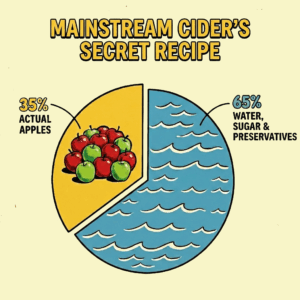
That figure should be surprisingly low to most cider drinkers. However, due to our current UK Customs & Excise definition of cider (a surprisingly long document known as Notice 162), it all just gets sold as “cider,” so long as it meets that minimum juice requirement.
This issue with our legislation has been written about and discussed at length by various champions of quality cider. This post, however, is about how we ended up with the lowest legal juice content for cider in the world.
This is going to get quite technical, so please bear with me.
Follow the Money
As ever with business, we start with money. Concentrated apple juice (“concentrate”) costs more than fresh apple juice because it costs money to process it. However, concentrate has three massive advantages for the industrial cider maker:
-
It can be stored indefinitely.
-
It can be shipped cheaply from other countries.
-
It can be over-diluted with water to create more juice than it started out as.
Points 1 and 2 are self-explanatory, but point 3 is the most relevant for this post.
The “Specific Gravity” Loophole
One litre of fresh juice typically weighs 1050 grams (g). One litre of concentrate typically weighs 1350g. During the concentration process, water is removed from the juice leaving behind the sugar and other non-watery stuff. But as you remove the water, obviously the overall volume is reduced.
So, for every seven litres of juice, you get just one litre of concentrate.
Theoretically, if I add six litres of water to my one litre of concentrate, I’d be back where I started with seven litres of juice (reconstituted) each weighing 1050g. But here’s the loophole: Notice 162 defines juice as weighing anything over 1035g per litre.
Note: This 1035g threshold was reportedly set to reflect traditional makers using early-season apples which have lower sugar content. While this makes sense for apples pressed in August, it created a massive loophole for industrial producers.
You can probably imagine what the industrious cider maker does when adding water to their concentrate. Yep, they add nine litres of water instead of six. This gives them ten whole litres of “juice” weighing 1035g/l. Legally, this is defined as 100% juice.
The Sugar Trick (Chaptalization)
So now we’ve got a tank full of this “juice,” but if fermented, it would only give us a cider with 4.5% alcohol. That would technically be a 100% juice (from concentrate) cider, but it would still be a touch too costly for the industrial cider maker to produce.
The solution is to add sugar to the “juice” to allow the yeast to raise the alcohol (Chaptalizing). Sugar is cheaper than juice.
If you add 182g of sugar per litre of “juice,” you’ll be able to produce a cider with an enormous 14% alcohol! Another benefit to the large-scale producer is storage space: 50,000 litres of 14% cider, once diluted, makes 140,000 litres of 5% cider. That means you can get away with just a third of the tank space required by a full juice producer.
The Final Dilution
Nobody sells 14% cider, of course, because Notice 162 states that cider cannot be stronger than 8.4%. So, what is actually done is that the cider maker once again turns on the hose and adds water back to the “cider” to bring the alcohol down to say 5% alcohol (a typical ABV for mass-produced UK ciders).
Diluting the “100% juice, 14% alcohol cider” down to 5% ABV means they need to add approximately 64 litres of water to every 36 litres of their high-strength base.
The Verdict: 26% Juice
And there we have it: a 5% ABV cider that legally conforms to UK legislation and will more than likely be sold as a “premium” or “craft” cider depending on when they last redesigned their labels.
The fact of it is that if you thought 35% apple juice was a little slim, then consider this final bit of maths. If we ignore the 1035g/l definition and return the concentrate back to its original density, you’re actually looking at an astonishing 26% juice.
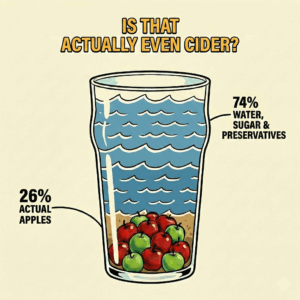
In light of this, who do you think sits around the table and decides what is and what isn’t cider? Who has the most influence on Notice 162: the cider maker using fresh juice and selling 100% juice cider, or the cider maker using concentrate, selling 35% juice “cider”?
Vote With Your Glass
If you drink cider at all, then you deserve better than that.
We work with fresh juice because we believe the apple should be the star of the show, not the water or the sugar. And we’re not alone. There is a whole movement of real cider makers in the UK fighting against this tide of dilution.
Seek out the real stuff. I know it can be hard to spot when every cider on the shelf looks the same but honestly: read the label.
The good cider makers don’t keep their ingredients or processes a secret. In many ways, transparency is the only tool we have to distinguish our cider from the fake stuff masquerading as cider on the supermarket shelves.
Cheers, and happy cider hunting!
Comments are closed